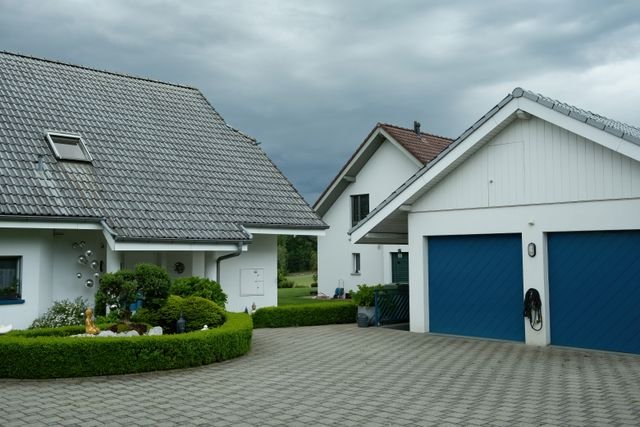
When a driveway starts at your property boundary and crosses the footpath, verge and kerb to reach the road, responsibility can become confusing. Homeowners often assume that the local council owns the entire entrance because it sits partly on public land. Others believe the concreter or builder must handle all approvals and repairs.
In South Australia, the general position is that the property owner is responsible for arranging, paying for, maintaining and repairing the driveway crossover. However, the council remains responsible for managing the public road reserve and approving work that affects it.
This distinction matters when you are building a new concrete driveway, widening an existing crossover, replacing damaged concrete or dealing with problems caused by council works. The exact rules can vary between councils, property titles and development arrangements, so it is worth confirming the requirements before work begins.
What Is a Driveway Crossover?
A driveway crossover is the section of vehicle access between the private property boundary and the public road.
It may include:
- The driveway section crossing the verge
- The part of the footpath used by vehicles
- The kerb or kerb layback
- The invert, which is the lowered kerb section allowing vehicles to enter
- Associated drainage or edge treatments
The private driveway inside your property is usually treated separately. For example, the concrete area between your garage and property boundary may be your private driveway, while the section between the boundary and road is the crossover.
This distinction is important because different responsibilities may apply to each area.
The City of Onkaparinga explains that property owners are responsible for constructing and maintaining driveway crossovers between the kerb and property boundary, while council remains responsible for the broader public road, kerbing and footpath networks.
Who Pays for a New Driveway Crossover?
The property owner generally pays
In South Australia, the property owner is generally responsible for the cost of constructing a new driveway crossover.
This can include:
- Council application or permit fees
- Site measurements and drawings
- Concrete or paving materials
- Excavation and preparation
- Kerb or invert alterations
- Footpath reinstatement
- Drainage adjustments
- Traffic or pedestrian management
- Removal of excess soil
- Repairs to damaged public infrastructure caused by the work
The responsibility can apply even though the crossover is located partly on council-controlled land.
Mount Barker District Council states that costs associated with constructing or altering driveway access, including changes to council infrastructure, are to be borne by the property owner. The same guidance explains that costs associated with relocating non-council services, such as telecommunications or electricity infrastructure, may also be the owner’s responsibility.
Does council construct the crossover?
Usually, councils do not construct new residential driveway crossovers as a free service. The owner generally engages a private contractor who completes the work in accordance with council’s approval and technical requirements.
Some councils may have specific arrangements for council-led road or footpath renewal projects. Those situations should not be confused with a homeowner independently installing a new crossover.
Who Is Responsible for Driveway Crossover Maintenance?
The property owner is generally responsible for the ongoing maintenance and repair of the crossover.
This may include:
- Cracked concrete
- Broken pavers
- Uneven surfaces
- Damaged kerb sections
- Deteriorated edges
- Trip hazards
- Drainage problems caused by the crossover
- Damage to the invert
- Repairs required after normal wear and tear
The responsibility can extend to the crossover section of the footpath, even though pedestrians use the surrounding public footpath.
The City of Holdfast Bay’s driveway crossover policy states that property owners are responsible for ongoing maintenance, including crossover sections that form part of the footpath network. It also allows council to require repairs where a crossover is unsafe or in poor condition.
If the owner does not complete required work within the specified timeframe, council may arrange the repairs and recover the cost from the property owner.
What standard must the crossover meet?
A crossover should remain safe, serviceable and consistent with the relevant council’s specifications.
A cracked private driveway may be a private maintenance issue. A broken crossover, however, may also create a pedestrian hazard or damage public infrastructure. Council may therefore become involved if the condition affects public safety.
Is Council Responsible for Damage to a Driveway Crossover?
The answer depends on what caused the damage.
Damage caused by the property owner or contractor
If damage occurs during private construction, excavation or driveway replacement, the owner or contractor may be responsible for rectifying it.
For example, if a concreter damages the footpath, kerb, drain or sign while installing a crossover, the property owner may be required to organise and pay for repairs.
The City of Port Adelaide Enfield advises applicants to photograph existing damage before construction. If pre-existing damage is not reported, the owner may have difficulty showing that it was not caused by the driveway works.
Damage caused by council works
Different rules may apply where council undertakes road, kerb or footpath renewal.
Some councils may replace or repair parts of an existing crossover that are affected by their own infrastructure works. However, the replacement may be completed using the council’s standard materials rather than matching the original decorative driveway finish.
Holdfast Bay’s policy, for example, explains that council may replace sections affected by council works, generally using plain grey concrete or materials matching the footpath. Ongoing maintenance of the replacement crossover then remains the owner’s responsibility.
Damage caused by utility providers
If a utility provider damages the crossover while completing works, the responsible party may depend on the circumstances, the work agreement and the relevant authority’s process.
Possible parties may include:
- Council
- SA Water
- SA Power Networks
- NBN or telecommunications contractors
- Private service contractors
- The property owner
Document the damage with dated photographs and contact the relevant authority promptly. Avoid assuming that council will automatically repair damage caused by a separate service provider.
Who Applies for Driveway Crossover Approval?
The property owner or applicant is generally responsible for making sure the required approval is obtained.
A contractor may submit the application on the owner’s behalf, but the owner should confirm:
- Who completes the application
- Who pays the application fee
- Who supplies the site plan
- Who communicates with council
- Who arranges inspections
- Who is responsible if the application is rejected
- Who pays for design changes
Under Section 221 of the South Australian Local Government Act 1999, approval is generally required to alter a public road to provide or facilitate access from adjoining land. This can include constructing or altering a driveway crossover.
The City of Norwood Payneham & St Peters explains that an application is required for crossover construction or maintenance works affecting the road, and that the works are undertaken at the owner’s cost.
Does Development Approval Cover the Crossover?
Not always.
A development application for a new home, extension, subdivision or townhouse project may show a driveway on the plans. However, approval for the building or development does not necessarily provide specific approval to alter public land.
The City of Norwood Payneham & St Peters specifically advises that development approval generally does not provide specific approval for works on public land. A separate crossover application may still be required, even when the driveway is shown on the approved development plans.
Before construction, ask both the builder and council whether the project needs:
- Development approval
- A public-road alteration approval
- A driveway crossover permit
- A footpath or verge approval
- Street tree approval
- Traffic management approval
- Utility provider approval
What Happens When a Crossover Becomes Redundant?
A crossover may become redundant when a property owner:
- Moves the driveway entrance
- Builds a new crossover elsewhere
- Removes a second driveway
- Changes a property from multiple access points to one
- Develops or subdivides the land
In many council areas, the redundant crossover must be removed and the kerb, footpath and verge reinstated.
The City of Port Adelaide Enfield states that redundant crossovers must be removed at the landowner’s expense. This can include removing the existing invert, reinstating an upright kerb, repairing the footpath and restoring the verge.
Norwood Payneham & St Peters also states that when a new crossover makes an existing crossover redundant, the owner bears the cost of reconstructing the kerbing.
This cost should be included in the project budget before work begins.
What About Shared Driveways and Community Titles?
Responsibility can be different for properties with shared access.
If several properties use a common driveway, the owner of the relevant land, community corporation or body corporate may be responsible for maintenance, depending on the title documents and scheme rules.
South Australian community-title guidance explains that common property may include shared driveways and that the community corporation is generally responsible for maintaining common property.
Before arranging repairs to a shared crossover, check:
- The certificate of title
- The community plan
- Strata or community-title by-laws
- Any maintenance agreement
- The location of the property boundary
- Whether the crossover serves one lot or several lots
Do not assume that one homeowner must pay the entire cost if the driveway is shared.
Common Mistakes to Avoid
Assuming council owns and maintains the crossover
Council may control the road reserve, but the property owner is generally responsible for the crossover itself.
Starting work without approval
A crossover affects public land. Obtain the relevant approval before changing the kerb, footpath or verge.
Believing a building permit covers everything
Development approval may not cover road-reserve works. Confirm whether a separate application is required.
Not documenting existing damage
Take dated photographs of the footpath, kerb, verge and crossover before construction begins.
Failing to clarify contractor responsibility
Put approval, construction, inspection and repair responsibilities in the written quote.
Forgetting redundant crossover removal
If a new entrance replaces an old one, budget for reinstating the redundant crossover.
Ignoring shared-title arrangements
For community-title or strata properties, check who owns and maintains the shared driveway and access areas.
Frequently Asked Questions
Is the homeowner responsible for the driveway crossover?
Generally, yes. In South Australia, the property owner is usually responsible for arranging and paying for construction, maintenance and repairs to the crossover between the property boundary and road.
Does council pay for a new crossover?
Generally, no. New crossover construction is usually paid for by the property owner. Different arrangements may apply if council undertakes infrastructure renewal or specifically requires works for a public project.
Who repairs a cracked driveway crossover?
The property owner is generally responsible for arranging repairs. If the damage was caused by council, a utility provider or another contractor, responsibility may depend on the cause and relevant arrangements.
Can my concreter organise the crossover permit?
Often, a contractor can assist or submit the application on your behalf. Confirm this in writing and make sure you receive a copy of the approval and conditions.
Who is responsible for a shared driveway crossover?
Responsibility may fall to the community corporation, body corporate, landowner or owners jointly, depending on the title structure and maintenance agreements.
What happens if an old crossover is no longer needed?
Council may require the redundant crossover and invert to be removed, with the kerb, footpath and verge reinstated at the property owner’s expense.
Final Thoughts
The general rule in South Australia is straightforward: the property owner is usually responsible for the driveway crossover, even though it sits partly within the public road reserve.
That responsibility commonly includes construction costs, approval arrangements, maintenance, repairs and reinstatement of redundant access points. Council remains responsible for managing the public road environment and assessing whether proposed works meet safety, drainage, streetscape and infrastructure requirements.
Before building or repairing a crossover, contact the relevant council and confirm the current rules for your property. Then choose a contractor who understands local specifications and clearly explains who will manage permits, construction, inspections and any required reinstatement.
A written quote and early council confirmation can help prevent disputes and unexpected costs later.